
Garage Heater Buying Guide for First-Time Homeowners
Choose the heater after you measure the garage, check insulation, confirm the outlet or fuel source, and verify clearances. For many attached two-car garages, a 4,000 to 5,000-watt electric unit or a properly vented 18,000 to 30,000 BTU gas heater is often a common starting point. Pick the wrong type or size, and you can waste money, trip breakers, or create a fire or carbon monoxide hazard. This guide covers garage size, insulation, outlet type, safety checks, and the heater features that fit a first-time homeowner budget.
What your garage needs first
The garage itself should choose the heater. Start with square footage, ceiling height, insulation quality, and how much colder the garage gets than the room temperature you want to maintain.
Measure length and width, then multiply them for square footage. Next, check ceiling height, because a garage with an 8-foot ceiling needs less heat than one with a taller ceiling of the same footprint. Higher ceilings increase cubic area, which means more air to warm and more heat loss to overcome.
Insulation matters just as much. An insulated garage has wall and ceiling insulation plus quality windows and a garage door. Non-insulated spaces require more heat than insulated spaces, especially when the door panel is thin or the windows leak cold air.
Temperature rise is the difference between the indoor temperature you want and the outdoor temperature you are starting from. A garage that needs to move from 25°F outside to 55°F inside needs a 30-degree rise. Cold-climate sizing should account for that gap instead of relying on square footage alone.
Picture a 20-by-20 garage with an uninsulated door and a 10-foot ceiling. That space has more volume and more heat loss than a similarly sized insulated garage with sealed windows, so the same heater may feel weak in one and adequate in the other.
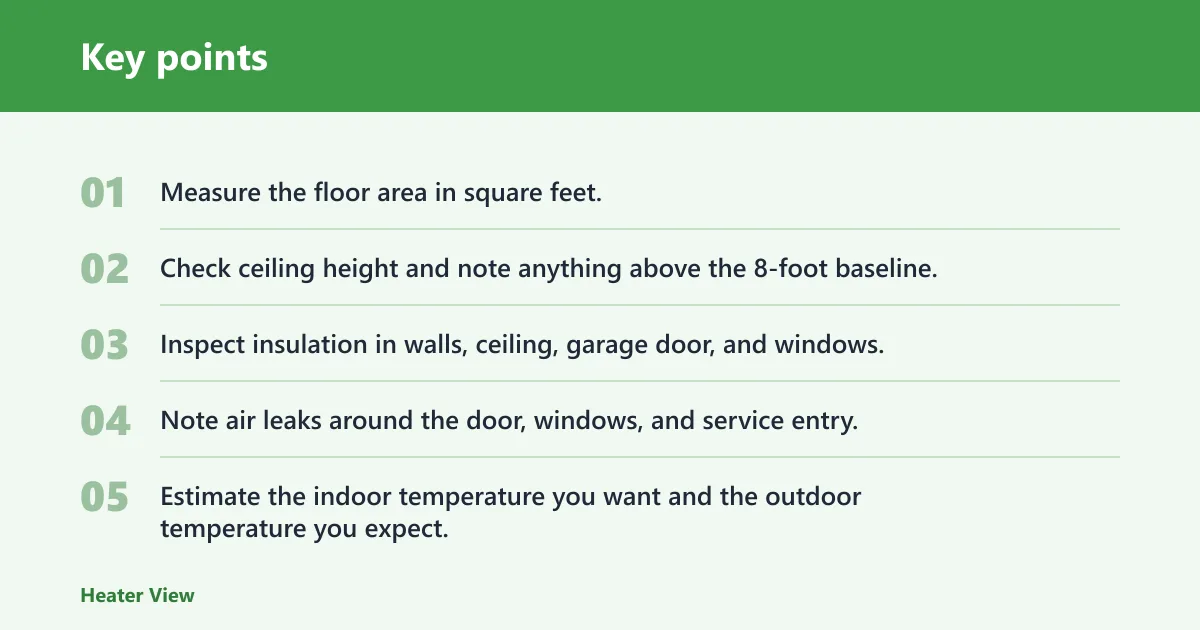
- Measure the floor area in square feet.
- Check ceiling height and note anything above the 8-foot baseline.
- Inspect insulation in walls, ceiling, garage door, and windows.
- Note air leaks around the door, windows, and service entry.
- Estimate the indoor temperature you want and the outdoor temperature you expect.
Which heater type fits your garage?
Match the heater to how you will use the space. Electric fan-forced units are common for steady heat. Radiant heaters fit spot heating. Gas, propane, kerosene, and diesel units belong in setups where fuel access, venting, and installation are already part of the plan.
Electric fan-forced heaters for steady heat
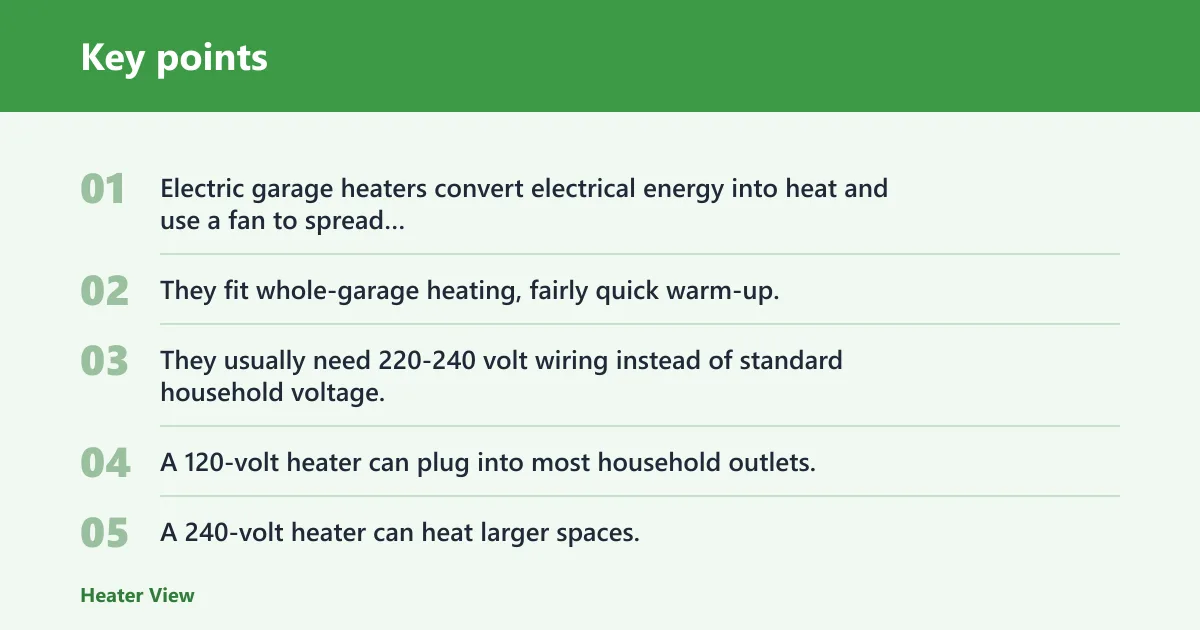
Electric garage heaters convert electrical energy into heat and use a fan to spread warmth. They fit whole-garage heating, fairly quick warm-up, and simple operation from a wall switch or thermostat. They usually need 220-240 volt wiring instead of standard household voltage.
A 120-volt heater can plug into most household outlets, but those units are usually smaller. A 240-volt heater can heat larger spaces, yet it will not work with most residential plugs. That is why the outlet and circuit matter before you shop.
Radiant or infrared heaters for spot heating
Radiant heaters warm objects in their path rather than the whole garage air. They work best when you are staying in one area, such as a workbench, and do not need the entire room warm at once. For small areas in a garage, radiant heaters are often the practical choice.
They heat faster in the line of sight, so they are useful when you care more about a warm work zone than about raising the temperature everywhere. They are less useful if you want the whole garage to reach a steady temperature before you start working.
Gas, propane, kerosene, and fuel access
Gas or diesel heaters are described as standard for industrial applications, and fuel-burning garage heaters can also be used in some residential setups when they are properly listed, properly vented, and installed to code. Fuel choice changes the job because you need access, storage, combustion air, and venting in place.
Natural gas, propane, kerosene, and gasoline all bring different storage and supply concerns. Propane and kerosene require safe storage. Natural gas depends on an available supply line. Gasoline is generally a poor fit for casual garage heating because storage and combustion control are harder to manage safely.
Say your detached workshop is 24 by 30 feet, with no existing electrical upgrade and a nearby propane supply already set up for other equipment. A properly vented fuel-fired heater may be more practical than adding a new 240-volt circuit, but the installation still needs code-compliant clearances and venting.
How much heater power do you need?
Use garage size, insulation, and ceiling height to narrow the wattage or BTU range. Small workshop heaters may use around 1,500 watts, while larger garage heating often uses heaters around 4,000-5,000 watts. Those figures are starting points, not automatic matches.
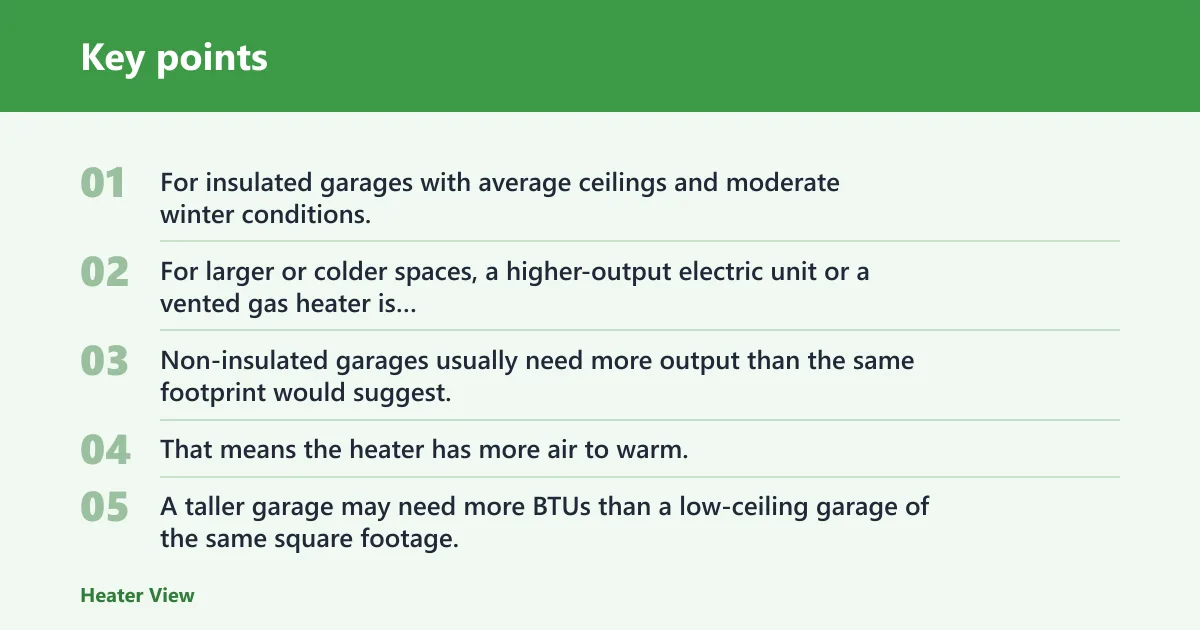
For insulated garages with average ceilings and moderate winter conditions, a smaller electric unit may cover a single-bay or partially used space. For larger or colder spaces, a higher-output electric unit or a vented gas heater is often a better fit. Non-insulated garages usually need more output than the same footprint would suggest.
Higher ceilings add cubic air volume. That means the heater has more air to warm, and the warm air may sit higher unless the fan and placement help circulate it. A taller garage may need more BTUs than a low-ceiling garage of the same square footage.
That may help near a bench or keep one corner tolerable, but it usually will not keep the whole garage comfortable in winter.
Another common mistake is oversizing without checking the circuit. A larger electric heater can demand more wiring capacity than the existing outlet or breaker can safely supply, so the heater choice has to follow the electrical system.
Do you need 120V or 240V?
The right voltage depends on the heater’s power draw and the circuit available in the garage. Check the breaker rating, wire gauge, and receptacle before you buy.
If you want a compact heater for occasional use, 120 volts may be enough. If you need more output for a larger garage, 240 volts is often the practical path, but only if the circuit can support it. A dedicated circuit or wiring check matters whenever the heater is near the upper end of what the garage can supply.
Do not assume a garage outlet is ready for a bigger heater just because it looks ordinary. The receptacle shape, breaker size, and wire capacity all matter. A heater that asks for more than the circuit can provide can trip breakers or force an unsafe workaround.
Garage heater decision table
| Garage scenario | Recommended heater type | Voltage | Approx. wattage or BTU range | Installation complexity | Key safety note |
|---|---|---|---|---|---|
| Attached, insulated | Electric fan-forced or radiant for spot use | 120V or 220-240V, depending on output | 1,500 watts to 4,000-5,000 watts | Low to moderate; plug-in or hardwired | Check clearances, garage storage, and circuit capacity before buying |
| Attached, uninsulated | Electric fan-forced or properly vented gas heater | Usually 220-240V for electric | 4,000-5,000 watts or about 18,000 to 30,000 BTU | Moderate to high; may need wiring or venting work | Heat loss is higher, so ventilation and code-compliant installation matter more |
| Detached, insulated | Electric fan-forced, radiant for spot heating, or vented gas | 120V for smaller units; 220-240V for larger units | 1,500 watts to 4,000-5,000 watts | Low to moderate | Detached placement gives more flexibility, but combustible storage still needs clearance |
| Detached, uninsulated | Properly vented gas or higher-output electric with upgraded circuit | Usually 220-240V for electric | 4,000-5,000 watts or about 18,000 to 30,000 BTU | High; often needs electrical or venting work | Heat loss is heavy, so plan for venting, fuel access, and a full wiring check |
Should you choose plug-in or hardwired?
Choose plug-in if you want simpler installation and your heater matches an existing outlet and breaker. Choose hardwired if the heater output is too high for a standard receptacle or if you want a more permanent setup. Installation style should follow the mount, the instructions, and local electrical codes.
Plug-in units are easier to move and replace. Hardwired units usually suit higher-output heaters, especially 240-volt models that are meant to stay in one place. A wall or ceiling mount can save floor space, but the mount must be rated for the heater and installed with proper clearances.
Professional installation becomes more likely when you need a new circuit, a new breaker, or a dedicated line for a 240-volt heater. It also makes sense when the unit is fuel-burning and the venting route has to be built correctly from the start.
What safety details matter most?
Safety starts with the fuel and the exhaust path. Electric heaters do not produce combustion byproducts, while gas, propane, kerosene, and diesel heaters do. That is why venting requirements, clearances, and code compliance matter much more for fuel-burning units than for electric ones.
Do not place any heater where stored solvents, paint, paper, or gas cans can crowd the intake or discharge path. Keep clearance around the unit and follow the manufacturer’s mount and installation instructions. Enclosed spaces need special care because airflow and exhaust handling are part of the system.
An attached garage deserves extra attention because it shares walls or air pathways with the home. That does not make every heater off-limits. It does mean a listed, properly vented model and a code-compliant installation are the safe route, especially when the garage connects to living space.
Detached garages usually offer more freedom, but they are not a shortcut around safety. You still need to consider combustion byproducts, fuel storage, and whether the heater is suitable for workshop use or only for occasional spot heat. A heater that is fine in an open workshop may be a poor match for a tightly enclosed room with poor airflow.
Frequently asked questions
What size garage heater do I need for my garage?
Start with square footage, ceiling height, insulation, and the outside-to-inside temperature gap. Non-insulated spaces usually need more output.
Should I choose an electric, gas, or infrared garage heater?
Choose electric if you want simple operation and no combustion exhaust. Choose infrared if you want quick spot heating near a bench or work area. Choose gas, propane, kerosene, or diesel only when fuel access, venting, and installation are already part of the plan and the unit is listed for garage use.
Do I need 120V or 240V for a garage heater?
Use 120V only when the heater is small enough to match a standard household outlet and the circuit can handle it. Use 240V when you need more output for a larger space. Check the breaker rating and wire gauge before buying, because many higher-output garage heaters need 220-240 volt wiring.
Is a garage heater safe in an attached garage?
Yes, if the heater is listed for the application, installed to code, and kept clear of storage and combustible materials. Attached garages need extra attention because they connect to the home. Fuel-burning models need proper venting, and electric models still need correct clearances and a circuit that matches the load.
How much does it cost to run a garage heater?
Running cost depends on heater size, how long it runs, local electric or fuel rates, and how well the garage holds heat. An insulated garage with sealed doors and windows usually costs less to heat than a drafty one. Bigger heaters and colder weather both increase the bill quickly.
Should I buy a portable or hardwired garage heater?
Buy portable if you want flexibility, occasional use, or a simple plug-in setup that matches an existing outlet. Buy hardwired if you need a larger 240V heater, want a permanent wall or ceiling mount, or plan to heat the garage often through winter. Hardwired units usually call for more installation work.