Can Infrared Heaters Heat Multiple Rooms?
Yes, but only if the rooms are open to one another and share the same airspace; closed-door rooms usually get spot heat only. Put one in the wrong place, and you waste electricity while leaving distant rooms cold. This guide explains how open layouts, placement, and coverage limits affect connected spaces.
Can infrared heaters heat multiple rooms?
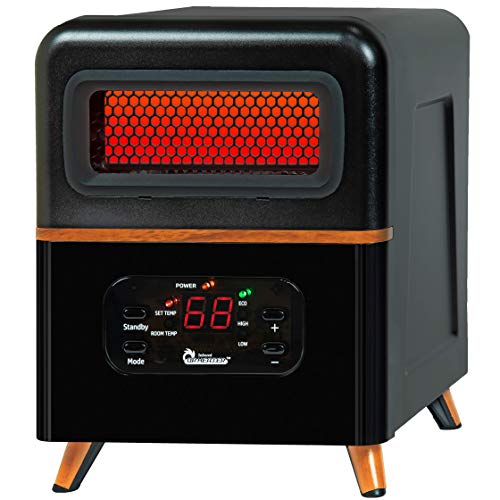


Sometimes. Infrared heaters can warm more than one room only when those rooms behave like one connected space, with open paths for heat and surfaces to absorb it. Once walls, closed doors, long hallways, or sharp corners break that path, the heater stops acting like a whole-area solution and starts acting like a spot heater.
Why connected airspace matters
Infrared heat does not rely on a fan pushing hot air across the home. It sends radiant energy toward people, furniture, floors, and walls first. Those warmed surfaces then pass some heat to nearby air. That works best when the rooms are visually and physically connected, because the warmed surfaces can keep exchanging heat with the same air mass.
A wide opening between rooms can let that happen. A narrow doorway can still work, but less predictably. Once the path includes a hallway or a corner, the heater’s effective reach drops quickly because the energy is no longer hitting the main surfaces in the far room.
When one heater can cover more than one room
One heater can cover two rooms at once when the rooms are open-plan, the doorway is wide and unobstructed, the ceiling is not unusually high, and the heater sits where its radiant path can reach both areas. That is supplemental heat behavior, not a substitute for central heat in closed rooms.
Say your kitchen opens directly into a small dining area with no door between them. A wall-mounted unit aimed toward the shared center can warm both spaces better than the same unit tucked into a corner facing a wall.
How infrared heat moves between rooms
Infrared heat travels as radiant energy, so it warms exposed surfaces and people before it warms the air around them. That makes it fast for comfort in one zone. It also means the heater depends on line of sight and surface exposure, which is why distance, angles, and barriers matter so much between rooms.
Radiant heat and warm surfaces
The heater’s output is strongest where it directly hits objects. In a connected layout, a floor, sofa, tabletop, or wall can absorb that energy and release some of it into nearby air. This is why infrared often feels immediate even when the room air is still catching up.
That same behavior limits multi-room use. If the second room does not receive direct radiant exposure, the heater is no longer warming it first. The farther room depends on heat drifting through shared air, and that process weakens fast as the layout gets more segmented.
What doorways and corners do to heat flow
Doorways create a bottleneck. Corners create shadowed zones where surfaces do not receive the same radiant load. Hallways add distance without adding much exposed surface area, so the warmer air has more places to mix and cool before it reaches the next room.
A common first-timer mistake is placing a heater in the living room and expecting it to warm a bedroom around a hall turn. The living room may feel fine. The bedroom often stays cool because the infrared beam does not bend around the corner.
Why closed doors stop the effect
Closed doors block line of sight and reduce shared air exchange. Once a door is shut, the heater can no longer radiate onto the far room’s surfaces in any meaningful way. At that point, the farther room gets little more than incidental heat leakage, which is usually not enough for comfort.
Multi-room heatability matrix
This matrix gives a practical way to judge connected rooms. It uses door position, distance, ceiling height, draft level, and heater placement to sort common layouts into yes, maybe, or no. Use it to judge whether one heater can cover the shared area, or whether you need a different setup.
| Layout | Door position | Distance | Ceiling height | Draft level | Heater placement | Recommendation |
|---|---|---|---|---|---|---|
| Open plan | No door or fully open passage | Short to moderate | Standard | Low | Centered or aimed across the shared area | Yes |
| Doorway-connected rooms | Open doorway, no closed threshold | Short | Standard | Low to moderate | Near the opening with clear line of sight | Maybe |
| Hallway-separated rooms | Rooms linked by a hall | Moderate to long | Standard to high | Moderate to high | Not ideal unless the hall is very short and open | No |
| Closed rooms | Closed doors between rooms | Any | Any | Any | Single-room placement only | No |
If the layout moves from open plan to hall-separated, the recommendation changes fast. The same heater can go from sensible to undersized without any change in wattage, because the room geometry changed the heat path.
What wattage can cover connected rooms?
Wattage matters, but it does not override layout. A 750W unit, a 1000W unit, and a 1500W unit all behave differently, yet even the larger model will struggle if the rooms are divided by doors or hallways. In connected spaces, higher wattage helps, but it still follows room shape and placement.
750W, 1000W, and 1500W
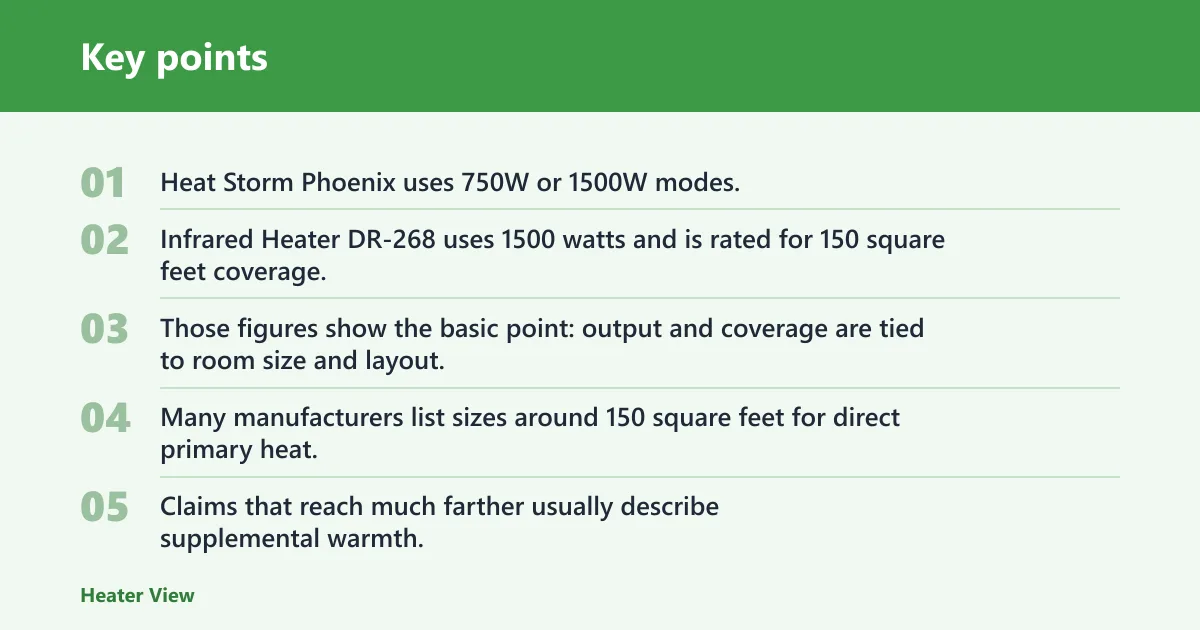
Heat Storm Phoenix uses 750W or 1500W modes, and its coverage is rated at 150 square feet for primary heat, with supplemental warmth up to around 750 square feet. Dr. Infrared Heater DR-268 uses 1500 watts and is rated for 150 square feet coverage. Those figures show the basic point: output and coverage are tied to room size and layout, not just the label on the box.
Many manufacturers list sizes around 150 square feet for direct primary heat, which is commonly treated as a practical range for easier warmth and control. Claims that reach much farther usually describe supplemental warmth, not even heating across every room in the span.
Coverage claims versus real room layout
A 1000W heater may be enough for a small open living-dining area, but it may not be enough for two enclosed rooms with a hallway between them. A wide opening can stretch the useful range. A drafty hall can shrink it. The same wattage can feel strong in one plan and weak in another.
That is why “up to 1,000 square feet” should be read as a broad supplemental claim, not a promise of even heat across that whole area. Insulation, ceiling height, and door position change the result.
When 150 sq ft, 750 sq ft, or 1,000 sq ft claims matter
Use about 150 square feet as the clearest target for direct primary heat. Treat supplemental warmth up to about 750 square feet as a comfort range for connected or partly open areas. Read up to about 1,000 square feet claims as conditional, especially when the space has low drafts, a modest ceiling, and few barriers.
Suppose a 500-square-foot open plan has one large opening and a low draft level. A 1500-watt heater may be enough for comfortable supplemental heat. Move the same heater behind a closed door, and the claim stops being useful.
Where should you place an infrared heater?
Place the heater where it has the clearest view of the main occupied area and the shared opening between rooms. For multi-room comfort, placement matters as much as wattage. A good position lets the radiant output strike the surfaces that matter most, instead of wasting energy on a wall, a cabinet, or an empty corner.
Best placement for open plans
In an open plan, place the heater so it can see the center of the combined space. Wall-mounted units work well here because they stay out of the traffic path and can be aimed at the main seating or work zone. Portable units also work if you can place them where both sides of the open area remain exposed.
Placement near shared doorways
For doorway-connected rooms, place the heater close to the opening, not deep inside one room. That keeps the radiant path aimed across the shared threshold. If the heater is too far back, the doorway itself becomes a barrier, and the far room gets less useful heat.
Why corners and hidden spots underperform
Corners hide surfaces from radiant output. Furniture, partitions, and tall objects do the same. If the heater sits behind a sofa or turns toward a blank wall, the heat is absorbed where you do not need it. The far room then gets even less, because the heater spent its output before reaching the shared opening.
Wall-mounted or portable: which works better?
Wall-mounted infrared heaters suit fixed zones and adjacent or open-plan rooms. Portable infrared heaters suit room-to-room movement, but they do not improve multi-room reach on their own. The main difference is placement control, not heat physics. If the layout blocks radiant flow, wheels will not fix that.
Wall-mounted infrared heaters for fixed zones
Wall-mounted models save floor space and can stay pointed toward the same connected area day after day. That makes them a strong fit for adjacent rooms that behave like one open space. Installation constraints matter, though, because you need a safe mounting point, clearance, and a location that does not aim heat at delicate surfaces.
Portable infrared heaters for room-to-room use
Portable heaters give you handles or wheels and make it easier to move the unit where the heat is needed most. That is useful when the goal changes from one room to another during the day. It is less useful when the goal is to heat two enclosed rooms at the same time.
Movement alone does not create multi-room heat. It only changes which room gets the spot heat. If the doors are closed, the second room still misses most of the output.
When a hybrid heater makes more sense
A hybrid infrared and convection heater can work better when you want faster mixing in a larger connected area. The fan-assisted portion moves warmed air farther than a pure radiant model, so the room feels more evenly conditioned. That can matter in broad, shared spaces where infrared alone feels too localized.
Fan-assisted heat distribution
Convection helps spread warmth after the heater has already warmed surfaces and nearby air. That makes hybrid units better at smoothing out temperature differences across a connected area. They are still not a cure for closed doors, but they handle wider open zones more efficiently than a pure radiant unit alone.
Faster mixing in larger connected areas
If the space is big enough that one side warms faster than the other, a fan can help move the heat. That is useful in open kitchens, large living rooms, or loft-style layouts. It is less useful in separate rooms, where the air cannot circulate freely between spaces.
What controls and ratings should you look for?
Thermostat control and ECO mode help manage comfort and energy use in supplemental heating setups. Tip-over and overheat protection matter for safety. IP55 and IP65 ratings matter for garages, patios, and damp areas, but they do not make a heater better at warming multiple indoor rooms.
Thermostat and ECO mode
A thermostat helps the heater cycle instead of running flat out. ECO mode usually trims output once the target temperature is close, which can reduce waste in a room that already gets enough radiant heat. That is especially useful when the heater is supplementing another heat source, not replacing it.
Do infrared heaters use less electricity? They can use less in a small, well-matched zone because they warm occupied surfaces quickly and can avoid long run times. That advantage is not automatic. If the unit is oversized, badly placed, or asked to heat too much separated space, energy use rises without equal comfort.
Tip-over and overheat protection
These safety features matter with portable units and busy households. Tip-over protection shuts the heater down if it falls. Overheat protection responds if internal temperatures climb too high. They do not change coverage, but they do make the appliance better suited to everyday indoor use.
IP55 and IP65 for garages or damp spaces
IP55 and IP65 ratings tell you the heater is built for harsher surroundings such as garages, covered patios, or damp utility spaces. That is about exposure resistance, not better room-to-room reach. A garage-rated unit can still be weak at heating two enclosed indoor rooms if the layout blocks radiant transfer.
Start with the room layout, not the box rating. Choose one heater for open plans or adjacent spaces that share air and sight lines. Move to two heaters when separate rooms need real comfort at the same time. For connected rooms, set the heater near the opening, use a thermostat if available, and keep the path clear.
- Check whether the rooms are open, doorway-connected, hallway-separated, or closed.
- Measure the main shared area and compare it with the heater’s primary coverage claim.
- Place the unit where it can see the most-used surfaces.
- Use thermostat or ECO mode to avoid running more output than the space needs.
- If a second room stays cold, add a second heater rather than expecting the first one to bend heat around barriers.
Frequently asked questions
Do infrared heaters heat the air?
They heat surfaces and people first, then those warmed surfaces pass heat to nearby air. That means the air does warm, but it is not the first target. In a closed room, the effect is useful. Across doors or hallways, the air transfer weakens fast because the radiant path is broken.
Do infrared heaters work well in multiple rooms?
They work well only when the rooms behave like one connected airspace. Open plans and wide doorway connections can work. Hallways, corners, and closed doors reduce the effect sharply. For separate rooms, a second heater is usually the better answer.
Can one infrared heater heat two rooms at once?
Yes, if both rooms are effectively one shared zone. That usually means an open plan or a wide doorway with short distance between the main occupied areas. Two enclosed rooms with a hall or closed door between them are usually beyond what one infrared heater can handle well.
How far does infrared heat travel between rooms?
There is no fixed distance that works in every home. The practical limit depends on line of sight, doorway width, ceiling height, and draft level. In real use, the farther room needs direct radiant exposure or very easy air exchange. Around corners and down hallways, the useful range drops quickly.
What size infrared heater do I need for connected rooms?
Match the unit to the shared area, not the combined square footage on paper. For a compact open zone, a 750W or 1000W unit may be enough. For a larger connected space, 1500W is a common upper step. If the layout is separated, size alone will not solve the problem.
Where should I place an infrared heater for best heat spread?
Place it where it has the clearest view of the main seating or work area and the shared opening between rooms. Avoid corners, furniture shadows, and hidden spots. In doorway-connected layouts, a position near the threshold usually works better than a position deep inside one room.
Do infrared heaters use less electricity?
They can, but only when the space matches the heater. Because they warm occupied surfaces directly, they may reach comfort faster in a small or connected area. If you ask one to cover too much separated space, the heater can run longer and lose that advantage.
Are infrared heaters any good for large rooms?
They can be, but only when the room is open, not drafty, and sized within the heater’s realistic coverage. Large rooms with high ceilings or poor insulation often need more than one heat source. Pure infrared also works better as supplemental heat than as a whole-room fix in very large spaces.